
Early Church Heresies (AD 33- 1400) A Review of the Heresies of the Pre-Reformation Era
Class Notes:
CFS Christian Heresies 0033 to AD1400
Lecture Audio:
From the very beginning of the Church’s founding by Christ in Matthew 16:18 (“I will build my Church,”) the enemy, Satan, has tried to derail, defame and destroy Her. Christ is the source of salvation by his life, death and resurrection, but the Church is the means by which He applies his plan of salvation to individuals.
Derail: Through lies and deceit about doctrine and dogma (see Appendix A for definitions)
Defame: Through scandals in the Church both moral and of division.
Destroy: Through persecuting the Church from without and within.
The True and Universal Christian Church Why is it important to emphasize the existence of a “single” church as the One True Church of Christ? The importance lies in the very nature of Christ’s relationship with his believers. If we are “the Body of Christ” and “the Bride of Christ,” then there can only be one body and one bride. (1 Cor 12:12, 2 Cor 11:2)
- In addition, Christ prayed for a unity in the Church that mirrors the unity of Jesus and his Father (Jn 17:21)
- Unity is a one of the “4 Marks” of the Church – One, Holy, Catholic and Apostolic.
Eph 4:4-6 There is one body and one Spirit, just as you were called to the one hope that belongs to your call, one Lord, one faith, one baptism, one God and Father of us all.
Unity does not mean that everyone agrees with all the teachings of the Church. It means that there is one teaching that is authoritative and apostolic for all.
Preservation of the Deposit of Faith
- St. Paul, in his first letter to Timothy, is clear about the importance of right Christian teaching. He writes to the young priest (or presbyter):
-
- 1 Tim 4:16 “Watch your life and doctrine closely. Persevere in them, because if you do, you will save both yourself and your hearers.”
-
Getting the Word of God (written and spoken) right matters. Popular spirituality is often expressed today: “Well, it doesn’t really matter what you believe, as long as you’re a good person.”
-
- Wrong interpretation – or twisting – of Scripture is not a light matter. It can lead to one’s “destruction.” Peter writes about St. Paul:
2 Pet 3:16 “His letters contain some things that are hard to understand, which ignorant and unstable people distort, as they do the other Scriptures, to their own destruction.”
- Wrong interpretation – or twisting – of Scripture is not a light matter. It can lead to one’s “destruction.” Peter writes about St. Paul:
We must avoid falling into the tragedy of religious indifference. This applies to Christians as much as the rest. “Liberal Christian indifferentism” occurs when believers in Christ throw up their arms and say, “It shouldn’t matter which church we go to as long as we all believe in the same Jesus!”
But it should matter because holding to the right doctrine is a matter of salvation. Being in full communion with the right Church means being in full communion with Christ. In the final analysis, what Jesus and the apostlesapostles In Christian theology, the apostles were Jesus’ closest followers and primary disciples, and were responsible for spreading his teachings. really taught really matters.
Why did groups split from the Church?
We will look at the chronological history of churches and theologies that separated from the church that Christ founded. There were different reasons for these splits, but human pride and a desire for power and control are common to all.
Key reasons for the formation of competing Christian churches:
-
- Theological Differences: Different interpretations of scripture regarding the nature of Jesus, the Trinity, salvation, interpretation of the Bible, and the role of the church led to various theological stances, causing splits within the Christian community.
-
- Historical Events: Major events like the Great Schism between the Eastern Orthodox and Roman Catholic churches, and the Protestant Reformation, resulted in significant divisions based on theological and political conflicts.
-
- Leadership Disputes: Power struggles between church leaders, including disagreements over papal authority, also contributed to the formation of new denominations.
-
- Social and Cultural Factors: Sometimes, cultural and social differences within a region influenced the development of distinct Christian groups.
The Development of the early Christian Church
The Catholic Church was founded by Jesus in 33 AD when he commissioned the Apostles to “go therefore and make disciples of all nations…” Matthew 28:19
The first Christian churches were local communities, starting with the one in Jerusalem consisting of Mary, Mary Magdalen, the Eleven, and others who witnessed the Resurrection and received the Holy Spirit at Pentecost.
As Christianity spread, most of the early writings, when referring to “Church,” refer to these local communities: The Church in Rome, the Church in Antioch, the Church in Corinth, etc.
About the time the last of the apostles dies, we have writing that indicates a name for the network or communion of all the local Christian churches – Saint Ignatius of Antioch in his Letter to the Smyrnaeans around 107–110 A.D. calls it The Catholic Church.
Within another few decades, this term Catholic Church clearly refers to the main, orthodox (correct teaching) Christian Church as opposed to other groups that arise claiming to be Christian: Marcionites, Montanists, Ebionites, Docetists, and eventually Arians and Gnostics.
From the earliest times, the Christian Church was the Catholic Church and vice versa. By the second century, it became necessary to distinguish these Catholic Christians from these other groups (Arian Christians, Marcionite Christians, etc). The Catholic Church was the one teaching faithfully and publicly what the apostles taught – it was where the gospel was rightly preached, and the sacraments rightly administered and where there was a clear line of succession of local apostolic churches in communion with each other.
Irenaeus, Against Heresies 3.3.2 (AD 180)
Since, however, it would be very tedious, in such a volume as this, to reckon up the successions of all the Churches, we do put to confusion all those who, in whatever manner, whether by an evil self-pleasing, by vainglory, or by blindness and perverse opinion, assemble in unauthorized meetings; [we do this, I say,] by indicating that tradition derived from the apostles, of the very great, the very ancient, and universally known Church founded and organized at Rome by the two most glorious apostles, Peter and Paul; as also [by pointing out] the faith preached to men, which comes down to our time by means of the successions of the bishops. For it is a matter of necessity that every Church should agree with this Church, on account of its pre-eminent authority, that is, the faithful everywhere, inasmuch as the apostolical tradition has been preserved continuously by those [faithful men] who exist everywhere.
Heresies and False churches in the First Five Centuries
We are familiar with the Great Schism of Eastern Orthodoxy in 1035 and The Protestant revolt in the early 1500s but there have been groups of people who thought they knew better than the church and went off to form their own religions almost from the beginning.
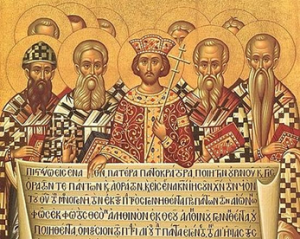
Warning about false teachers that contradict and distort church teaching
Most heresies in the first five centuries centered around differing opinions on exactly who Christ was, what manner of being he was, and what the relationship was between Christ and God the Father. The term comes from the Greek haireseis, which can mean “the act of choosing,” but was also occasionally used in the Bible to mean sect or party.
Gnosticism
The primary form of Christian heresy in the early Church was Gnosticism. The term comes from the Greek word gnosis, meaning knowledge.
Some Gnostics viewed Christ as a great prophet, but not as being divine. Many Gnostics believed in Dualism, or the view that there are two Gods of equal power in the Universe – one evil (who created the world and all material things), and one good (who created all spiritual and heavenly things). The “evil” God was often associated with the Old Testament God. The battle between the good god and the evil god was often expressed in terms of the battle of the Kingdom of Light vs. Kingdom of Darkness.
They believed there were different spiritual levels of human beings. Those on the highest level were guaranteed salvation; those on the lowest level were denied salvation and everyone in between had to fight for salvation. Some Gnostics believed in Docetism (from Gr. dokesis, or semblance), which viewed that Christ was a pure spirit, not a flesh and blood human being. This view comes out of the dualist viewpoint that matter is created from the “evil” God, thus a manifestation of the “good” God could never exist in a carnal, fleshly form.
Some modern religions, such as the Church of Jesus Christ of Latter Day Saints (Mormons) retain versions of these gnostic errors.
In the early years of Christianity, prideful men tried to pervert the true message of the gospel. We will look at some of the specific heresies in the first five centuries, and the response of the early Church fathers. Much of Christian doctrine in the Early Church was developed to refute these early heresies:
Founder Dates Name of Movement Type of Heresy
Simon Magus 1st century Gnostic
Valentinus 2nd century Gnostic
Marcion 85-160 AD Gnostic
Mani 216-276 AD Manichaeism Gnostic
Donatus 314 AD Schismatic
Arius 250-336 AD Arianism Schismatic
Pelagius Died 418 AD Pelagianism Schismatic
Nestorius Died 440 AD Nestorianism Schismatic
Lecture Two Audio File:
Simon Magus – circa 37 AD
Several of the Early Church Fathers, including Irenaeus, Hippolytus, and Justin Martyr believed that Christian Gnosticism started with Simon Magus (see Acts 8:9-24). The quote below is from Irenaeus’ Against Heresy:
“Simon the Samaritan was that magician of whom Luke, the disciple and follower of the apostles, spoke of…Such was his procedure in the reign of Claudius Caesar, by whom also he is said to have been honored with a statue, on account of his magical power. This man, then, was glorified by many as if he were a God; and he taught that it was himself who appeared among the Jews as the Son…Now this Simon of Samaria, from whom all sorts of heresies derive their origin…” (Irenaeus, Against Heresies, Chapter 23)
Valentinus
One of the most influential of the early “Christian” Gnostics was Valentinus (c. 137), who established schools in Egypt, Cyprus and Rome. According to Tertullian, Valentinus was denied the sought-after post of Bishop, and then turned against the established church. “…Valentinus, who adapted the principles of the heresy called “Gnostic” to the peculiar character of his own school…” (Irenaeus, Against Heresies, Book 1, Chapter 11)
Marcion
Marcion (c. 85 – c. 160 A.D.) was a Gnostic ship owner, who believed that there were two Gods in the universe (dualism) – the God depicted in the Old Testament, and the God represented by Jesus in the New Testament. He believed also that Jesus was a spirit (docetism) and did not appear in the flesh. As such, he rejected the infancy narratives about Jesus, as well as the crucifixion and resurrection.
Marcion was excommunicated in Rome in 144 A.D. and his sect died out by the end of the 3rd century. According to Tertullian, Marcion attempted to reconcile himself to the church before his death: “Marcion expressly and openly used the knife, not the pen, since he made such an excision of the Scriptures as suited his own subject-matter.” (Tertullian, Prescription Against Heretics”
Mani
Manichaeism was one of the most influential Gnostic movements of the first several centuries A.D., and it survived well into the Middle Ages in one form or another. Its Persian founder Mani (216? – 276 A.D.) created a religion that was a curious blend of Gnosticism, Christianity, and the teachings of Persian Magi. Among the characteristics of Manichaeism:
The most famous convert to Manichaeism was St. Augustine, who repudiated Manichaeism in 384 A.D. and later stated: “Through the assisting mercy of God, the snares of the Manichaeans having been broken to pieces and left behind, having been restored at length to the bosom of the Catholic Church, I am disposed now at least to consider and to deplore my recent wretchedness.” (St. Augustine, On Two Souls, Against the Manichaeans).
Donatus
Donatism was the error taught by Donatus Magnus, bishop of Carthage (present day Tunisia), that the effectiveness of the sacraments depends on the moral character of the minister. The roots of the Donatist schism date back to the 3rd century. In c. 250 A.D., Roman Emperor Decius ordered the persecution of Christians and the issue was raised as to whether or not clergy that committed apostacy be allowed back into the Church.
In time, the Donatists became a schismatic sect, claiming that they were the only true Christians. The Donatists refused to accept baptisms performed in the Catholic Church, claiming they were invalid. The Donatists also insisted that a baptism performed by an “impure” priest was not valid.
Donatism continued to survives in pockets in Africa until Islam conquers the region (late 600s).
The Donatists were banished by emperor Honorius in 412 A.D. and completely disappeared by the end of 7th century.
Lecture Audio Day Three:
Arius
The great theological debates of the 2nd century centered on who was Christ exactly and what manner of being he was. In the early 4th century, the debate switched to what the relationship was between Christ and God the Father. Some church officials, such as a presbyter in Alexandria named Arius (c. 250 -336 A.D.) argued that Jesus was divine, but on a lower level then the Father. Arius started with this premise: “One God, alone unbegotten, alone everlasting, alone unbegun, alone true, alone having immortality, alone wise, alone good, alone sovereign.”
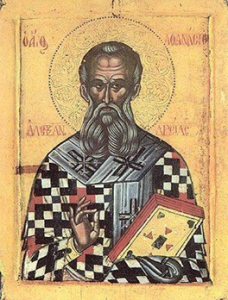
St. Athanasius, who argued successfully against the views of Arius
From this starting point, Arius ended up with the view that Christ was an intermediary distinct from the Father (or that there was a difference, but similar substance (homoiousia), or essential being between the Father and the Son.)
In 325 A.D. Constantine, emperor of the Roman Empire ordered that the debate be settled once and for all. A great church council was ordered, and it took place at Nicea (in modern day Turkey). Arius lost the debate, and the view of Athanasius became the view of the church. The doctrine of homoousios versus homoiousios was affirmed that Christ was of one (the same) substance with the Father. Out of the Council came the Nicene Creed.
The Council of Nicaea I (325) condemned Arianism and taught that Christ was “true God from true God,” “begotten not made, one in essence with the Father.” It declared that Rome, Alexandria and Antioch were the three great dioceses or patriarchates of Christianity.
Arianism was perhaps the greatest threat to the Early Church out of all the schisms and heresies. By some estimates, almost half of all Christians were Arians at its peak in the 4th century. Although condemned by the Council of Nicea in 325 A.D., it didn’t die out completely until the 8th century. The Goths and other Germanic peoples who ruled Rome in the 5th and 6th centuries were Arian Christians. There are still groups today (such as the Unitarians and their theological offspring – the Mormons) who, like Arius, reject Trinitarianism.
Pelagius
Pelagius (c. 354 A.D. – after 418) was a British Monk who was horrified by the seeming lack of piety and purity practiced by Christians in Rome c. 380 A.D. He felt that the laxness of Roman Christians grew partly from the prevailing doctrine of Grace, which stated that humans on their own are incapable of purity and can only be saved by God’s grace.
Pelagius and his followers denied predestination, original sin, and the doctrine of Grace, maintaining the humans are not tainted by the sin of Adam and Eve, and that babies are born pure. As a result, humans have the free will to choose to live sinless lives.
The main opponent to Pelagianism was St. Augustine of Hippo. Augustine wrote at least thirteen works and letters against Pelagius and firmly entrenched in Catholic theology the doctrines of: salvation through grace, original sin, and the necessity of baptism for salvation.
Pelagius was excommunicated in 418 A.D. and his teaching was declared heretical at the Council of Ephesus (431 A.D.).
With the condemnation at the Council of Orange (529), Pelagianism dies out
Nestorius
Nestorius argues that there were two separate natures in Christ. Christ was a “Man who became God” rather than “God who became Man.” As such, Jesus of Nazareth and the Word were united. He tended to view Christ as a prophet and teacher, inspired by an indwelling logos. Christ was the first “perfect man.”
In 428 Nestorius objects to calling Mary Theotokos (“God-bearer”), but Cyril of Alexandria defends the term and condemns Nestorius. In 431The Council of Ephesus declares Mary Theotokos and condemns Nestorianism. In 451, The Council of Chalcedon condemns Nestorians, who gradually moved to Persia and further east to form their own church. This was the start of the Oriental Orthodox Churches.
Nestorius himself was exiled to the Egyptian desert in 435 A.D. and Nestorianism diminished in popularity in the 5th century. However, there are still Nestorian churches in Iran and Iraq. And many Kurdistan Nestorians moved to San Francisco after World War I.
Forms of Gnosticism return with Paulicians (800s) and Albigensians (1200s)
Chalcedonian Schism
The Council of Chalcedon (451) taught that in Christ there was but one person with two natures, that is, human and divine, versus the Monophysites, who held for one person with one nature, that is, divine, thus endangering Christ’s true human identity.
The schism between Oriental Orthodoxy and the rest of the Church occurred in the 5th century. The separation resulted in part from the refusal of Dioscorus, the Patriarch of Alexandria, to accept the Christological dogmas promulgated by the Council of Chalcedon on Jesus’s two natures (divine and human). The Oriental churches accepted that Christ had two natures but insisted that those two natures are inseparable and united.
Oriental Orthodox Churches
Oriental Orthodoxy is the communion of Eastern Christian Churches that recognize only three ecumenical councils—the First Council of Nicaea, the First Council of Constantinople and the Council of Ephesus. They reject the dogmatic definitions of the Council of Chalcedon. Hence, these Churches are also called Old Oriental Churches or Non-Chalcedonian Churches. They split from the Catholic Church in 451 A.D. as a result of Christological differences.
This group of breakaway churches had major theological differences from the teachings of the Catholic Church. The later schism in 1054 AD that led to the formation of Eastern Orthodox churches was about authority and control. What we now know as the Eastern Orthodox churches retained most of the theology of the Catholic Church. The names of the Oriental and Eastern Orthodox churches are similar but their doctrines are quite different.
Today, the Oriental Orthodox Church is most prominent in Armenia, Ethiopia (highest concentration), Egypt, Sudan, Syria, and parts of India.
The Great Schism
The Great Schism of 1054 AD, is the break of communion between the Catholic Church and the Eastern Orthodox Church. A series of ecclesiastical differences and theological disputes between the Greek East and Latin West preceded the formal split that occurred in 1054. Prominent among these were the procession of the Holy Spirit (Filioque), whether leavened or unleavened bread should be used in the Eucharist, iconoclasm, the coronation of Charlemagne as Emperor of the Romans in 800, the Pope’s claim to universal jurisdiction, and the place of the See of Constantinople in relation to the pentarchy (the five major episcopal sees of the Roman Empire: Rome, Constantinople, Alexandria, Antioch, and Jerusalem).
The Great Schism began when the Pope of Rome and the Patriarch of Constantinople excommunicated each other, declaring the other church heretical.
The Latin-speaking church in the west and the Greek-speaking church in the east were divided over the pope’s claim to universal, jurisdictional authority and the theological understanding of Filioque, that is, that the Holy Spirit “proceeds from the Father and the Son,” a phrase added to the Nicene-Constantinopolitan Creed by the Western church. These disagreements involving patriarchs, popes, emperors, and councils led to misunderstandings and eventually to separation.
There are now 17 Eastern Orthodox churches. These are Christian churches that have complete administrative and canonical independence and are able to elect their own bishops and primates.
The largest Patriarchates with approximate membership:
• Moscow-112,000,000
• Constantinople-1,500,000
• Alexandria—3,000,000
• Antioch-300,000
• Jerusalem-150,000
• Bulgaria-6,500,000
• Serbia—7,000,000
Heresies in the Middle Ages
Although Europe was mostly Catholic throughout the Middle Ages, there were a number of movements which questioned the Church’s teachings and sought to establish their own version of Christianity or, as in the case of the Paulicians, Bogomils, and Cathars, a kind of sister-religion which drew on the tenets of Persian Manichaeism, Greek Gnosticism, and Christianity.
Although there were many heretical movements throughout the Middle Ages, these four had the greatest impact and would inspire others:
• Paulicians
• Bogomils
• Cathars
• Waldensians
Paulicians (7th-9th centuries)
The Paulicians were founded in Armenia by Constantine-Silvanus (d. 684) and advocated a return to the simplicity and communion of early Christianity as expressed in the life of Saint Paul (l. c. 5- c. 67). They had no churches and met in the homes of adherents which they called “Places of Prayer.”
They were a dualist faith, believing in two all-powerful deities (one good, one evil) in constant struggle and rejected the divinity of Christ and the veneration of Mary as well as all the sacraments and the hierarchy of the Church.
Constantine-Silvanus was stoned to death by order of the Church, and afterwards, many other of his followers were burned at the stake for heresy or were relocated in the hope they would reform. These survivors developed, or at least influenced, the heresy of the Bogomils.
The Paulicians were a Gnostic heretical sect that combined elements of dualism and Docetism. They rejected the Old Testament and the Cross and honored only the Gospels. They also rejected St. Peter’s epistles because he had denied Christ.
The Paulicians were displaced by the Bogomils and gradually disappeared from history.
Bogomils (11th century)
The Bogomils were a religious sect formed in the Balkans whose name is Slavic and most likely means “those dear to God”. The Bogomils were also a dualist sect but developed the concept more completely. They believed that the world belonged to the evil deity and the purpose of life was to overcome this world’s temptations and free oneself of the constraints of the body in order to return to the pure realm of God. They followed Paulician tenets in denying the divinity of Christ, the validity of the sacraments, and the hierarchy of the Church, but included more Manichaean elements in their faith as well as aspects of Greek Gnosticism.
The Church tried to eradicate them through a number of crusades, but their tenets and basic organizational structure survived to influence the best-known heresy of the Middle Ages – Catharism.
Today, some dualistic, Gnostic elements of Bogomilism can be found in some religions in the region, and some folklore of the southern Baltic Slavs remains.
Cathars (11th-13th centuries)
Cathar comes from the Greek for “pure ones”, also known as Albigensians for their association with the town of Albi, were a sect in Southern France who followed the same essential beliefs as the Bogomils but, as with that sect and the Paulicians, developed the concepts further.
The Cathars were also dualist and gnostic but venerated a feminine divine principal Sophia (wisdom) whom they claimed the Church had abducted and whose message the Church had perverted.
Cathar clergy were known as perfecti, and believers were credentes. Men and women served as perfecti who practiced abstinence, vegetarianism, and lived in poverty, standing in stark contrast to the Catholic clergy. They were suppressed by the Church through the Albigensian Crusade and were eventually eradicated in the early 14th century. The last known Cathar perfecti in the Languedoc was burned at the stake in 1321.
Waldensians (12th century)
The Waldensians were a sect distinct from the previous three, founded in c. 1177 by Peter Waldo (l. c. 1140-1205) of Lyons, France. Waldo was a wealthy merchant who, seeking a closer relationship with God based on Christ’s teachings. He gave away his wealth and preached a doctrine of simplicity, poverty, and service to others.
Prior to distributing his wealth to the poor, he paid for the Bible to be translated into Provençal, his native language, and preached Christ’s message directly from that work. Waldo and his followers condemned the worldly aspects of the Church – most notably The Donation of Constantine which they felt contradicted Christ’s teachings directly – as well as denying the validity of the sacraments (except for baptism and communion), the existence of purgatory, and veneration of the saints and the Virgin Mary. When Waldo appealed to Pope Alexander III in 1179 for acceptance, he was not considered a heretic but was discouraged from preaching. Afterwards, however, the Waldensians were condemned for their criticisms of the Church, branded heretics, and fled to the mountains of Italy to escape persecution.
References
Betts, Robert B. Christians in the Arab East Athens: Lycabbetus Press, 1978.
Binns, John. An Introduction to the Christian Orthodox Churches (Introduction to Religion). Cambridge University Press, 2002.
Charles, R. H. The Chronicle of John, Bishop of Nikiu: Translated from Hermann Zotenberg’s Ethiopic Text. Evolution Publishing, 1916. Reprinted 2007. ISBN 978-1-889758-87-9
Harakas, Stanley H. The Orthodox Church; 455 Questions and Answers. Light and Life Publishing Company, 1988. ISBN 0-937032-56-5
Ware, Timothy. The Orthodox Church. Penguin Books, 1997. ISBN 0-14-014656-3
https://en.wikipedia.org/wiki/History_of_Oriental_Orthodoxy
Appendix A
In the Catholic Church, dogma and doctrine are related but distinct concepts.
-
- Dogma refers specifically to truths revealed by God that the Church has formally defined and declared as binding on believers. These are considered infallible and must be accepted with divine and Catholic faith.
-
- Doctrine encompasses all Church teaching in matters of faith and morals, which includes dogmas but also other teachings that are not formally defined as dogmas. While dogmas are divinely revealed and infallible, doctrines can be either infallible or fallible, depending on the manner of their teaching and acceptance within the Church.
Heretics, Heresy, and History: A Review of the Heresies of the Reformation Era
Heresies, Schisms, and Denominations: AD 1400 to Now
Class Notes:
CFS Christian Heresies 1400 to Present
Lecture Audio Day Four:
In the early church prior to the Protestant uprising, the ancient and medieval schisms and heresies were about Christological and Trinitarian errors (e.g. Arianism and Gnosticism) or power and authority conflicts like the great east-west schism of AD 1054 that started the Eastern Orthodox churches. In the 15th and 16th Centuries we see individuals and groups that affirm the Nicene creed and have a correct Trinitarian view of God, but claim to know the interpretation of sacred scripture better than the Catholic Church. They form new churches to preach and practice their heresies in conflict with the Catholic Church.
The Protestant premise that we have been taught in this country is that the Catholic Church is one among the many denominations of churches, and that Christ’s true church is a collection of all believers and doesn’t exist in any one institution. In fact, we are taught that the Catholic Church became corrupt and unholy during the Middle Ages and fell away from the true faith.
The groundwork for the heresies of the 1500s
The invention of the printing press in the 1400’s by Guttenberg, the increase in the number and influence of Universities (mostly sponsored and created by the Catholic church), and the increasing wealth of churches were all factors that made the Protestant revolution possible.
The political dynamic was changing by the 1500s in central and northern Europe. In what was to become Switzerland, Germany and the Netherlands there wasn’t a strong central government. It was a loose confederation of smaller states and provinces ruled by princes and nobles. In contrast, France and Great Britan were unified under one king with feudal lords owing allegiance to the monarch.
Protestant Heresies (AD 1300 to AD 1600)
The 1300s and 1400s – Proto-Reformation Schisms
John Wycliffe in England and Jan Hus in Bavaria were influential dissenters from the teaching of the Catholic church in the late Middle Ages.
Oxford professor and English priest, John Wycliffe (1330-1384) had followers called Lollards. They wanted to develop a new Christian church that changed key doctrines. In 1395, the Lollards issued their document Twelve Conclusions of the Lollards which condemned: celibacy of the clergy, the ministerial priesthood, payment for prayers for the dead, the Crusades, transubstantiation, the primacy of St. Peter, oral tradition, and other dogmas.
Wycliffe was protected by Oxford under academic freedom of expression, but after the Peasants’ Revolt of 1381, in which at least one notable peasant leader was a Lollard, both the Church and State persecuted the sect. They were an underground movement throughout the 15th century and emerged as a reputable sect after the English Reformation.
Hussites were followers of the philosopher and theologian Jan Hus (1369-1415), rector of the Charles University in Prague, who admired Wycliffe’s work and advocacy for changes in doctrine. Hus and his followers frequently quoted Wycliffe’s writings – which had been banned by the Church in the Kingdom of Bohemia – and based their own advocacy on his.
When Anne of Bohemia became the queen of Richard II, of England, John Huss accompanied her train to London as chaplain, where he heard John Wickliffe preach and was exposed to his false doctrines. As he was a professor at the University of Prague, he began teaching others the new tenets.
Hus was brought to trial for his stand and other remarks he had allegedly made and was burned at the stake in 1415. His death ignited the Hussite Wars of 1419 – 1434 between Hussites and forces loyal to the Catholic Church. The Hussites, like the Lollards, merged into various new sects during the Protestant Reformation and the ideas of Wickliffe and Huss were later adopted by Martin Luther and his followers.
The 1500s – The Protestant Revolt
Martin Luther was an academic Augustinian Friar who saw excesses and corruption in the church and spoke out against them. He wasn’t unique in the effort. Over the centuries many individuals acted in good faith to help the church correct itself as it suffered through the errors caused by being an institution run by mortal, weak and sinful people. In fact, entire religious orders had been formed by reform minded individuals acting with the support of their pope.
Luther decided that the Church that created the Holy Bible was wrong in their selection of the canon and removed 7 books from the Old Testament. He even proposed deleting several New Testament books that he felt didn’t support his ideas (specifically James and the book of Revelation).
After the precedent was set with what became known as Lutheranism the path was clear for every dissenter and political leader to form their own church and make up their own theology. Luther was followed quickly by Zwingli, Calvin, and the Anabaptists who all had different ideas from Luther and formed their own churches. King Henry the XIII of England saw his chance to steal the wealth and power of the Catholic church in England and formed his own state religion.
Reformation Timeline:
The main forms of the new churches were created between 1521 and 1536. Once the heretics felt comfortable with the protection of their monarchs and rulers their ideas and institutions developed rapidly and spread across northern and western Europe.
1517 – Martin Luther’s 95 Thesis
Luther writes the Ninety-five Theses. This document criticizes the selling of indulgences. Protestants consider publication of the theses to be the beginning of the Reformation.
1521 – Luther’s bonfire – The Lutheran Churches
Martin Luther was declared a heretic and publicly burned a copy of the papal decree excommunicating him in defiance of the church.
1522 – Ulrich Zwingli – The Reformed Churches
The Reformation spreads to Switzerland. Former priest Ulrich Zwingli disagreed with Luther’s theology and founded the breakaway Swiss Reformed Church. Zwingli’s ideas formed the basis of the reformed tradition.
Zwingli’s changes included:
• A new communion liturgy to replace the Mass.
• Abolishing veneration of saints, relics, and images.
• Allowing priests to marry.
Like Martin Luther, he accepted the supreme authority of the Scriptures, but he applied it more rigorously and comprehensively to all doctrines and practices.
Zwingli’s ideas influenced the doctrines and practices of the Reformed churches today. They also influenced the English Puritans, who sought to purify the Church of England.
Zwingli was radical enough that his sect started a war in Switzerland over political control that resulted in his death on the battlefield.
1525 – The Anabaptist Churches
The reform movement splinters further when a group in Switzerland believed that a more radical renewal of Christian life was needed. This group became known as the Anabaptists. They believe in pacifism, adult baptism, and separation of church and state. Quakers, Baptists, Mennonites, and Hutterites all have their origins in the Anabaptist movement.
• Anabaptists (to baptize again) believed that baptism by infants was illegitimate and unscriptural. They re-baptized their members.
• They believed that the church should be a voluntary gathering of believers who discipline and encourage each other.
• They believed that the church should be separate from the state – that government should not determine a person’s church affiliation.
• They were pacifists.
• They believed that Christians should not claim possessions for themselves, lie, or use violence
1526 – The Diet (“Assembly”) of Speyer
The German princes divided themselves into two parties. Six princes supported Luther, and the rest remained loyal to the Catholic Church.
1531 – Lutheranism spreads to Scandinavia
Laurentius Petri becomes a Protestant archbishop in Sweden. He is one of the leaders of the Reformation in that country. Eventually, most of Sweden converts to Lutheranism.
1534 – The Anglican Churches
England’s King Henry VIII breaks with the pope. Henry establishes the Anglican church with himself at its head. Archbishop Thomas Cranmer was a strong supporter of the views of the reformers. The Church of England:
• Discontinued priestly celibacy.
• Removed images from the churches
• Conducted worship according to a new formula based on “The Book of the Common Prayer”
1536 – John Calvin
In Switzerland, French lawyer John Calvin publishes Institutes of the Christian Religion. He did not protestant churches (e.g. Presbyterian).
Calvin was a follower of Martin Luther and sought to systematize Luther’s new theology. During the process he changed elements of the theology to conform to his own ideas and codified a stricter doctrine that became known as Reformed Christian theology.
Calvin started the false narrative that the early Christian church wasn’t the Catholic Church. He referred to Ignatius of Antioch’s letters as fairy tales because they plainly affirm that in the generations following Jesus’ death that the church was indeed Catholic.
1547 – John Knox
John Knox establishes the Protestant Calvinist religion in Scotland.
1579 – The Unitarians
Italian reformer Faustus Socinus moves to Poland and establishes what will become the Unitarian movement. They reject the doctrine of the Trinity.
Lecture Audio Day Five:
Protestantism by the end of the 1500s
There were four major groups of churches formed during the reformation: Lutheran, Reformed, Anabaptist, and Anglican. Most Protestant sects have a correct Christian trinitarian view of God.
Common Protestant Doctrinal Inventions:
• Eternal security (once saved always saved): Calvin was the first to teach this false doctrine – it did not exist anytime in the 1500 years prior.
• The Five Solas are five Latin statements that summarize the core beliefs of the Protestant Reformation:
o Sola Gratia: Salvation is a gift of grace from God, not a result of human merit.
o Sola Fide: Salvation is found in faith in Jesus Christ alone.
o Solus Christus: Salvation is found in Christ alone.
o Sola Scriptura: The Bible is the sole authority for Christians in faith, doctrine, and practice. The Scriptures are self-revealing and can be privately interpreted.
o Soli Deo Gloria: Salvation is a work of God for His glory.
• Two sacraments: baptism and the holy eucharist.
• Priesthood of all believers
• Married clergy – some allow women to serve as priests.
The new protestant sects not only rejected the authority of the Catholic Church, but they also differ in significant ways from each other. These differences combined with political or national agendas of the local rulers explain the large number of Christian denominations that we see today.
Key differences between the major early branches of Protestantism
Lutherans hold to the common beliefs but differ in some sacramental and liturgical practices.
Reformed churches hold to the common beliefs and add:
• From all eternity God predestines some to be saved and others to be damned.
• Every human person is totally corrupt by reason of original sin.
• The true church of Christ is an invisible reality whose members are known only to God because they are predestined to salvation. The institutional church is a visible reality whose members include both those destined for salvation and those destined for perdition.
• The eucharist does not contain the actual body and blood of Christ, which is in heaven, but is a memorial of Christ’s passion which unites the believer spiritually to the risen Christ.
• The church is governed according to a presbyterian form of polity in which ordained presbyters or pastors share responsibility for the life and good order of the community with lay elders.
• The state or local government is obliged to conduct itself in accord with the gospel norms proposed by the church.
Anabaptists hold to the common beliefs and add:
• Adult baptism: They believe baptism should only be administered to adults who have made a personal commitment to Christ.
• Separation of church and state: Reject involvement in government affairs and refuse to hold public office, seeing their primary allegiance to the church community.
• Pacifism: Refusing to participate in war or violence.
• Community living: Some Anabaptist groups, like the Hutterites, live in communal settings where property is shared
Anglicans add:
• Some Anglicans recognize all seven sacraments.
• Most Anglicans don’t accept the real presence in the eucharist.
• The Anglican Church historically saw itself as navigating between Lutheranism and Reformed Christianity.
A contrast of Catholic and Protestant world views:
The Catholic version of a religious world view had its roots in the Aristotelian-Thomistic synthesis of the Middle Ages. There, a person was understood to be created in the image of God, capable of doing good and empowered to do so by grace. Christ was the universal savior, leading all persons of good will to salvation.
The various Protestant versions of the Christian world view generally emphasized the terrible, corrupting effects of original sin on the human person. This view leaned heavily on the Platonic theology of St. Augustine. Salvation was by no means guaranteed and, in fact, probably would not be the destiny for most people. A Christian life was test, trial, and dependence totally on the gratuitous action of God. John Calvin, for instance, taught a double pre-destination, whereby some were predestined for heaven, while others were predestined to hell.
1600 to Present – Scattering of the Protestant Churches
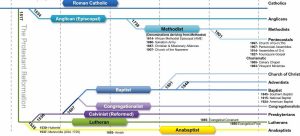
The Family Tree of Protestant Denominations
Protestantism in America
English supporters of Calvin, the Puritans, had a profound impact on the development of the values and ideals of the American spirit through their colonies in New England.
Many Protestant sects originated or expanded into new churches in America, with many major denominations finding their roots in the United States due to the country’s founding principle of religious freedom, which allowed for the development of new Protestant denominations.
Descendants of the Major Branches of Protestantism
(estimates of the worldwide populations in parenthesis)
Lutheranism (87,000,000)
The Lutheran church began in the German states that supported Lutheranism and opposed the Catholic Church.
By the time of Martin Luther’s death in 1546 The Lutheran Church had spread across Northern Europe and Scandinavia. During the 16th century the monarchs of Denmark, Norway, and Sweden adopted the faith, and it became the state religion.
1649: A Lutheran parish was formed in the New Amsterdam (New York), which is the oldest surviving Lutheran congregation in the American colonies.
There are now over 150 Lutheran churches worldwide. Some are national churches in Europe and others are synods of local churches who group together based on common ideas. The two largest groups in the U.S. are the Evangelical Lutheran Church in America and the Lutheran Church Missouri Synod.
Evangelical Lutheran Church in America (2,700,000)
The Evangelical Lutheran Church in America is a mainline Protestant church headquartered in Chicago, Illinois. The ELCA was officially formed on January 1, 1988, by the merging of three Lutheran church bodies.
The next two largest Lutheran denominations are the Lutheran Church–Missouri Synod (with over 1.7 million members) and the Wisconsin Evangelical Lutheran Synod (with approximately 340,000 members). There are also many smaller Lutheran church bodies in the United States, some formed by dissidents to the major 1988 merger. Its members are largely descendants of Scandinavians and Germans who emigrated from countries where Lutheranism was the state religion.
Anabaptism (4,500,000)
Anabaptism is a Christian movement which traces its origins to the Radical Reformation in the 16th century. Anabaptists believe that baptism is valid only when candidates freely confess their faith in Christ and request to be baptized. Commonly referred to as believer’s baptism, it is opposed to baptism of infants, who are not able to make a conscious decision to be baptized.
The early Anabaptists formulated their beliefs in a confession of faith in 1527 called the Schleitheim Confession. Anabaptist groups varied widely in their specific beliefs, but the Schleitheim Confession represents foundational Anabaptist beliefs as well as any single document can.
Other Christian groups with different roots also practice believer’s baptism, such as Baptists, but these groups are not Anabaptist, even though the Baptist tradition was influenced by the Anabaptist view of Baptism.
The first Anabaptists to arrive in North America were Dutch “Menists” who settled in New York as early as 1644. The first Anabaptist groups to permanently settle in North America were Mennonites, who arrived in Philadelphia in October 1683. Most of the first Mennonites were of Dutch origin, but a second wave of Swiss Mennonites arrived in the early 18th century.
The largest Anabaptist denominations:
Mennonites (1,500,000)
Mennonites are a group of Anabaptist Christian communities tracing their roots to the epoch of the Radical Reformation. The name Mennonites is derived from the cleric Menno Simons (1496–1561) of Friesland, part of the Holy Roman Empire, present day Netherlands. Menno Simons became a prominent leader within the wider Anabaptist movement and was a contemporary of Martin Luther.
Through his writings about the Reformation Simons articulated and formalized the teachings of earlier Swiss Anabaptist founders as well as early teachings of the Mennonites founded on the belief in both the mission and ministry of Jesus. Formal Mennonite beliefs were codified in the Dordrecht Confession of Faith (1632), which affirmed “the baptism of believers only, the washing of the feet as a symbol of servanthood, church discipline, the shunning of the excommunicated, the non-swearing of oaths, marriage within the same church”, nonresistance, and in general, more emphasis on “true Christianity” involving “being Christian and obeying Christ” as they interpret it from the Holy Bible.
Amish (250,000)
The Amish are a group of traditionalist Anabaptist Christian church fellowships with Swiss and Alsatian origins. As they maintain a degree of separation from surrounding populations, and hold their faith in common. The Amish are closely related to Old Order Mennonites and Conservative Mennonite denominations that are also a part of Anabaptist Christianity. The Amish are known for simple living, plain dress, Christian pacifism, and slowness to adopt many conveniences of modern technology, with a view neither to interrupt family time, nor replace face-to-face conversations whenever possible, and a view to maintain self-sufficiency. The Amish value rural life, manual labor, humility and Gelassenheit (submission to God’s will).
Anglicanism – (85,000,000)

Anglicanism is a Western Christian tradition which developed from the practices, liturgy, and identity of the Church of England following the English Reformation, an offshoot of the Protestant Reformation in Europe.
Differences between Catholic and Anglican churches:
• Married and female ordained clergy
• Deny transubstantiation – the real presence of Christ in the eucharist
• Deny the authority of the pope
Anglicanism forms a branch of Western Christianity, having definitively declared its independence from the Holy See at the time of the Elizabethan Religious Settlement. Thomas Cranmer, the archbishop of Canterbury, and others designed Anglicanism as a middle way between Lutheranism and Calvinism.
Anglicanism in America:
The first recorded Anglican service in North America was held in 1579 by Sir Francis Drake’s crew in San Francisco Bay. The first verifiable Anglican service in America was held in 1607 in Jamestown, Virginia, under the charter of the Virginia Company of London.
Episcopal Church in the U.S.A. (2,400,000)
The Protestant Episcopal Church in the United States of America is a member church of the worldwide Anglican Communion based in the United States with additional dioceses elsewhere
The church was organized after the American Revolution, when it became separate from the Church of England, whose clergy are required to swear allegiance to the British monarch as Supreme Governor of the Church of England.
Methodism (75,000,000)
Methodism, also called the Methodist movement, is a Protestant Christian tradition whose origins, doctrine and practice derive from the life and teachings of John Wesley. Methodism originated as a revival movement within Anglicanism with roots in the Church of England in the 18th century and became a separate denomination after Wesley’s death. The movement spread throughout the British Empire, the United States and beyond because of vigorous missionary work.
Wesleyan theology focuses on sanctification and the transforming effect of faith on the character of a Christian. Distinguishing doctrines include the new birth, assurance, imparted righteousness, and obedience to God manifested in performing works of piety.
John Wesley held that entire sanctification was “the grand depositum,” or foundational doctrine, of the Methodist faith and its propagation was the reason God brought Methodists into existence.
Scripture is considered the primary authority, but Methodists also look to Christian tradition, including the historic creeds. Most Methodists teach that Jesus Christ, the Son of God, died for all of humanity and that salvation is achievable for all. This is the Arminian doctrine, as opposed to the Calvinist position that God has pre-ordained the salvation of a select group of people. However, Whitefield and several other early leaders of the movement were considered Calvinistic Methodists.
Methodism was introduced into America by Irish immigrants who had been converted by John Wesley. Wesley also sent preachers, the most successful of whom was Francis Asbury, a blacksmith, who arrived in 1771. He adapted Wesley’s principles to the needs of the settled communities and of the frontier.
During the next 50 years the church made advances led by the circuit riders who preached to the people on the frontier in simple terms.
United Methodist Church (12,000,000)
The United Methodist Church (UMC) is a worldwide mainline Protestant denomination based in the United States, and a major part of Methodism. In the 19th century, its main predecessor, the Methodist Episcopal Church, was a leader in evangelicalism. The present denomination was founded in 1968 in Dallas, Texas, by union of the Methodist Church and the Evangelical United Brethren Church. The UMC traces its roots back to the revival movement of John and Charles Wesley in England, as well as the Great Awakening in the United States. As such, the church’s theological orientation is decidedly Wesleyan. It embraces liturgical worship, holiness, and evangelical elements.
The United Methodist Church is organized into conferences. The highest level is called the General Conference and is the only organization which may speak officially for the UMC. The church is a member of the World Council of Churches, the World Methodist Council, and other religious associations.
African Methodist Episcopal Church (3,000,000)
The African Methodist Episcopal Church, usually called the AME Church or AME, is a Methodist denomination based in the United States. It adheres to Wesleyan–Arminian theology and emphasizes connections between individual churches over a centralized structure. It cooperates with other Methodist bodies through the World Methodist Council and Wesleyan Holiness Connection.
Though historically a black church and the first independent Protestant denomination to be founded by Black people, the African Methodist Episcopal Church welcomes and has members of all ethnicities.
Pentecostalism/Charismatic (612,000,000)
Pentecostalism is a Protestant Charismatic Christian movement that emphasizes direct personal experience of God through baptism with the Holy Spirit. The term Pentecostal is derived from Pentecost, an event that commemorates the descent of the Holy Spirit upon the Apostles and other followers of Jesus Christ while they were in Jerusalem celebrating the Feast of Weeks, as described in the Acts of the Apostles (Acts 2:1–31).
Like other forms of evangelical Protestantism, Pentecostalism adheres to the inerrancy of the Bible and the necessity of the New Birth: an individual repenting of their sin and “accepting Jesus Christ as their personal Lord and Savior.” It is distinguished by belief in both the “baptism in the Holy Spirit” and baptism by water, that enables a Christian to “live a Spirit-filled and empowered life”.
This empowerment includes the use of spiritual gifts: such as speaking in tongues and divine healing. Because of their commitment to biblical authority, spiritual gifts, and the miraculous, Pentecostals see their movement as reflecting the same kind of spiritual power and teachings that were found in the Apostolic Age of the Early Church. For this reason, some Pentecostals also use the term “Apostolic” or “Full Gospel” to describe their movement.
Roots of Pentecostalism: Many scholars trace the roots of Pentecostalism to John Wesley and early Methodism. Some consider Wesley a “proto-Pentecostal”.
Methodism and Pentecostalism share commonalities in their:
• Theologies of holiness
• Emphasis on the sanctifying work of the Holy Spirit
• Pattern of reading the Bible
Charles Fox Parham, a former Methodist, was an important figure in the emergence of Pentecostalism. He started Bethel Bible School near Topeka, Kansas in 1900.
The Azusa Street Revival was a Pentecostal gathering that occurred in Los Angeles, California, in April 1906. Most of today’s Pentecostal denominations point to the Azusa Street Revival as the catalyst of the worldwide growth of the Charismatic movement, as they believe the Holy Spirit was once again poured out in a “new Pentecost.”
Other influences on Pentecostalism include:
• The Holiness movement spread from England to America in the 1840s and 1850s to preserve John Wesley’s doctrine of ‘Christian Perfection’. The Holiness movement emphasized purification from sin and the power of the Holy Spirit. John Wesley regarded Christian Perfection, or Entire Sanctification, as a second experience of grace, distinct from conversion
• Speaking in Tongues: The Pentecostal doctrine of “the initial, physical evidence” of speaking in tongues is the thought that at the time of Spirit baptism the believer will speak in tongues.
• John Wesley, believed that Christ’s atonement provided for purification of the human nature from sin, in addition to justification from sin. Having held that sickness was caused by sin, he believed that the experience of entire sanctification, purifying human nature from sin, would restore complete health to the body.
• Premillennialism: A belief that Jesus Christ will return to Earth after a period of tribulation and reign on Earth for a thousand years.
Lecture Audio for Day Six:
Assemblies of God (60,000,000)
The World Assemblies of God Fellowship is a global cooperative body of over 170 Pentecostal denominations that was established on August 15, 1989. It was created to provide structure so that member denominations, which previously related to each other informally, could more easily cooperate on a global basis. Member denominations are independent and autonomous, but they are united by shared beliefs and history.
New Apostolic Church (11,200,000)
The New Apostolic Church has existed since 1863 in Germany and since 1897 in the Netherlands. It came about from the schism in Hamburg in 1863, when it separated from the Catholic Apostolic Church, which itself started in the 1830s as a renewal movement in, among others, the Anglican Church and Church of Scotland.
The Second Coming of Christ is at the forefront of the New Apostolic doctrines. Most of its doctrines are akin to mainstream Protestantism.
The church considers itself to be the re-established continuation of the Early Church and that its leaders are the successors of the twelve apostles. This doctrine resembles Restorationism in some respects.
Foursquare Church (8,000,000)
The Foursquare Church is an international Evangelical Pentecostal Christian denomination founded in 1923 by evangelist Aimee Semple McPherson. Its headquarters are in Los Angeles, California.
The church has its origins in a vision of “Foursquare Gospel” (or “Full Gospel”) during a sermon in October 1922 in Oakland, California, by the evangelist Aimee Semple McPherson who was originally an ordained evangelist of the Assemblies of God where she once exerted a large influence until the split
Church of God in Christ (6,500,000)
The Church of God in Christ is an international Holiness–Pentecostal Christian denomination, and a large Pentecostal denomination in the United States. Although an international and multi-ethnic religious organization, it has a predominantly African-American membership based within the United States.
Reformed Churches
Reformed Churches (75,000,000).
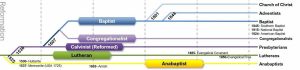
Reformed Christianity, also called Calvinism, is a major branch of Protestantism that began during the 16th-century Protestant Reformation. In the modern day, it is largely represented by the Continental Reformed, Presbyterian, and Congregational traditions, as well as parts of the Anglican (known as “Episcopal” in some regions) and Baptist traditions.
Reformed theology emphasizes the authority of the Bible and the sovereignty of God, as well as covenant theology, a framework for understanding the Bible based on God’s covenants with people. Reformed churches have emphasized simplicity in worship. Several forms of ecclesiastical polity are exercised by Reformed churches, including presbyterian, congregational, and some episcopal. Articulated by John Calvin, the Reformed faith holds to a spiritual presence of Christ in the Lord’s Supper.
Key differences between Lutheran and Reformed theology:
• Lord’s Supper: Reformed theology interprets the Lord’s Supper as a spiritual presence of Christ, while Lutheranism teaches a real physical presence of Christ’s body and blood in the elements.
• Predestination: Reformed theology tends to emphasize a more robust doctrine of predestination, where God has predetermined who will be saved, while Lutheranism focuses on God’s grace extended to all people, with individual faith as the key to salvation.
• Application of Law: Lutherans often present a sharper distinction between the Law (which reveals sin) and the Gospel (which offers forgiveness), viewing the Law primarily as a tool to drive people to Christ, while Reformed theology sees the Law as having ongoing application in the life of a believer.
• Church Structure: Reformed churches often have a more congregational structure with elected elders, while Lutheran churches tend towards a more episcopal model with bishops.
Presbyterian Church U.S.A. (3,000,000)
Presbyterianism is a Reformed (Calvinist) Protestant tradition named for its form of church government by representative assemblies of elders. Though other Reformed churches are structurally similar, the word Presbyterian is applied to churches that trace their roots to the Church of Scotland or to English Dissenter groups that formed during the English Civil War.
The Presbyterian denomination was taken to North America, mostly by Scots and Scots-Irish immigrants. Scotland’s Presbyterian denominations hold to the Reformed theology of John Calvin and his immediate successors, although there is a range of theological views within contemporary Presbyterianism. Local congregations of churches are governed by sessions made up of representatives of the congregation (elders), a conciliar approach as with other levels of decision-making (presbytery, synod, and general assembly).
United Church of Christ (1,000,000)
The United Church of Christ (UCC) is a socially liberal mainline Protestant Christian denomination based in the United States, with historical and confessional roots in the Congregational, Restorationist, Continental Reformed, and Lutheran traditions, and with approximately 4,600 churches and 712,000 members.
The Evangelical and Reformed Church, General Council of the Congregational Christian Churches, and the Afro-Christian Convention, united on June 25, 1957, to form the UCC. In 2015, Pew Research estimated that 0.4 percent, or 1 million adult adherents, of the U.S. population self-identified with the United Church of Christ.
Congregationalism (2,400,000)
Congregationalism is a Reformed (Calvinist) tradition of Protestant Christianity in which churches practice congregational government. Each congregation independently and autonomously runs its own affairs. Congregationalism may have first developed in London in the late 1560s and 1570s.
Robert Browne (1550–1633) was the first person to set out explicit congregational principles and is considered the founder of Congregationalism. While studying for ordination, Browne became convinced that the Church of England was a false church. He moved to Norwich and together with Robert Harrison formed an illegal Separatist congregation. In 1581, Browne and his followers moved to Holland in order to worship freely. While in Holland, Browne wrote treatises that laid out the essential features of Congregationalism.
In the United Kingdom, the Puritan Reformation of the Church of England laid the foundation for these churches. In England, the early Congregationalists were called Separatists or Independents to distinguish them from the similarly Calvinistic Presbyterians, whose churches embraced the governance by elders.
Facing persecution in England, the Puritans and other separatists came to America in the 1620s and 30s as the Mayflower Pilgrims and later in the Puritan great migration. They established their congregational churches in New England and profoundly influenced the founding of our nation.
Baptist (100,000,000)
Baptists are a denomination of Christianity distinguished by baptizing only professing Christian believers (believer’s baptism) and doing so by complete immersion.
Baptist churches have their origins in a movement started by John Smyth and Thomas Helwys in Amsterdam. Because they shared beliefs with the Puritans and Congregationalists, they went into exile in 1607 with other believers who held the same biblical positions.
In 1612 Helwys established a Baptist congregation in London, consisting of congregants from Smyth’s church. A number of other Baptist churches sprang up, and they became known as the General Baptists. The Particular Baptists were established when a group of Calvinist Separatists adopted believers’ Baptism.
Both Roger Williams and John Clarke are variously credited as founding the earliest Baptist church in North America. In 1639 Williams established a Baptist church in Providence, Rhode Island, and Clarke began a Baptist church in Newport, Rhode Island.
Some Baptist church congregations choose to be independent of larger church organizations (Independent Baptist). Other Baptist churches choose to be part of an international or national Baptist Christian denomination or association while still acting as an independent congregation. This cooperative relationship allows the development of common organizations, for mission and societal purposes, such as humanitarian aid, schools, theological institutes and hospitals.
Baptist denominations are traditionally seen as belonging to two parties, General Baptists who uphold Arminian theology that salvation is achievable for all; and Particular Baptists who uphold Reformed theology that God has pre-ordained the salvation of a select group of people (Calvinism).
Southern Baptist Convention (16,000,000).
The Southern Baptist Convention is a Christian denomination based in the United States. It is the world’s largest Baptist organization, the largest Protestant, and the second-largest Christian body in the United States. The SBC is a cooperation of fully autonomous, independent churches with commonly held essential beliefs that pool some resources for missions.
Churches affiliated with the denomination are evangelical in doctrine and practice, emphasizing the significance of the individual conversion experience. This conversion is then affirmed by the person being completely immersed in water for a believer’s baptism. Baptism is believed to be separate from salvation and is a public and symbolic expression of faith, burial of previous life, and resurrection to new life; it is not a requirement for salvation.
The denomination has a male pastorate, often citing 1 Timothy 2:12 as the reason it does not ordain women. All affiliated churches deny the legitimacy of same-sex marriage, saying that marriage can only be between a man and a woman and also that all sexual relations should occur only within the confines of marriage. Other specific beliefs based on biblical interpretation vary by congregation, often to balance local church autonomy.
Non-Denominational Evangelicalism (40,000,000)
Non-denominational Christianity consists of churches, and individual Christians, which typically distance themselves from the confessionalism or creedalism of other Christian communities by not formally aligning with a specific Christian denomination.
In North America, nondenominational Christianity arose in the 18th century through the Stone-Campbell Restoration Movement, with followers organizing themselves simply as “Christians” and “Disciples of Christ”. The nondenominational movement saw expansion during the 20th century Jesus movement era, which popularized contemporary Christian music and Christian media within global pop culture.
Many nondenominational churches adhere to congregationalism, while others are governed by elders. Some nondenominational churches are independent, while others cooperate in loose associations such as the Churches of Christ; in other cases, nondenominational churches are founded by individual pastors such Calvary Chapel Association established by Chuck Smith.
Calvary Chapel (25,000,000)
Calvary Chapel is an international association of charismatic evangelical churches, with origins in Pentecostalism. It maintains a number of radio stations around the world and operates many local Calvary Chapel Bible College programs.
Beginning in 1965 in Southern California, this fellowship of churches grew out of Chuck Smith’s Calvary Chapel Costa Mesa.
The association has its origins in the founding of a Calvary Chapel Costa Mesa (California) in 1965 by pastor Chuck Smith of the International Church of the Foursquare Gospel with 25 people. In 1968 they broke away from Foursquare Church. Prior to Smith, Costa Mesa members spoke of their own vision of becoming part of a massive church movement.
The Vineyard (15,000,000)
The Association of Vineyard Churches, also known as the Vineyard Movement, is an international neo-charismatic evangelical Christian association of churches.
The Vineyard Movement is rooted in the charismatic renewal and historic evangelicalism. Instead of the mainstream charismatic label, however, the movement has preferred the term Empowered Evangelicals to reflect their roots in traditional evangelicalism as opposed to classical Pentecostalism. Members also sometimes describe themselves as the “radical middle” between evangelicals and Pentecostals.
The Vineyard has its origins in the founding of a Calvary Chapel church in 1974, in Los Angeles. These Bible studies, and others like them, were attended by many popular actors/actresses and musicians including Bob Dylan.
Non-Denominational Mega Churches
The first megachurch in the United States was the Angelus Temple, founded in 1923 by Aimee Semple McPherson in a 5,300-seat auditorium in Los Angeles.
A study by the Hartford Institute published in 2020 found that 60 percent of American megachurches were members of a Christian denomination. The remaining consider themselves non-denominational.
Joel Osteen’s Lakewood church and Conroe’s The Ark churches are non-denominational.
Kerry Shook’s The Woodlands Church is part of the Evangelical Free Churches of America. Shook is a Baptist.
Restorationism (20,000,000)
Restorationism, also known as Christian primitivism, is a religious perspective according to which the early beliefs and practices of the followers of Jesus were either lost or adulterated after his death and required a “restoration.” It is a view that often “seeks to correct faults or deficiencies, in other branches of Christianity, by appealing to the primitive church as normative model.”
Efforts to restore an earlier, purer form of Christianity are frequently a response to denominationalism. As Rubel Shelly put it, “the motive behind all restoration movements is to tear down the walls of separation by a return to the practice of the original, essential and universal features of the Christian religion.” Different groups have tried to implement the restorationist vision in a variety of ways; for instance, some have focused on the structure and practice of the church, others on the ethical life of the church, and others on the direct experience of the Holy Spirit in the life of the believer. The relative importance given to the restoration ideal, and the extent to which the full restoration of the early church is believed to have been achieved, also varies among groups.
Seventh-day Adventists (17,000,000)
The Seventh-day Adventist Church is an Adventist Protestant Christian denomination which is distinguished by its observance of Saturday, the seventh day of the week in the Christian (Gregorian) and the Hebrew calendar, as the Sabbath, its emphasis on the imminent Second Coming (advent) of Jesus Christ, and its annihilationist soteriology.
The denomination grew out of the Millerite movement in the United States during the mid-19th century, and it was formally established in 1863. Among its co-founders was Ellen G. White, whose extensive writings are still held in high regard by the church.
Much of the theology of the Seventh-day Adventist Church corresponds to common evangelical Christian teachings, such as the Trinity and the infallibility of Scripture. Distinctive eschatological teachings include the unconscious state of the dead and the doctrine of an investigative judgment.
The church emphasizes diet and health, including adhering to Jewish dietary law, advocating vegetarianism, and its holistic view of human nature—i.e., that the body, soul, and spirit form one inseparable entity. The church holds the belief that “God created the universe and in a recent six-day creation made the heavens and the earth, the sea, and all that is in them, and rested on the seventh day.” Marriage is defined as a lifelong union between a man and a woman. The second coming of Christ and resurrection of the dead are among official beliefs.
Church of Christ (5,000,000)
The group of churches known as the Christian Churches and Churches of Christ is a fellowship of congregations within the Restoration Movement (also known as the Stone-Campbell Movement and the Reformation of the 19th Century) that have no formal denominational affiliation with other congregations but still share many characteristics of belief and worship.
Churches in this tradition are strongly congregationalist and have no formal denominational ties, and thus there is no proper name that is agreed upon and applied to the movement as a whole. Most (but not all) congregations in this tradition include the words “Christian Church” or “Church of Christ” in their congregational name.
Christian Church (Disciples of Christ) (1,000,000).
The Christian Church (Disciples of Christ) is a Protestant Christian denomination in the United States and Canada. The denomination started with the Restoration Movement during the Second Great Awakening, first existing during the 19th century as a loose association of churches working toward Christian unity. In 1968, the Disciples of Christ officially adopted a denominational structure. At that time, a group of churches left in order to remain nondenominational.
The denomination is referred to by several versions of its full name, including “Disciples of Christ,” “Disciples,” “Christian Church” and “DOC”.
The Disciples’ local churches are congregationally governed.
Non-Trinitarianism – (36,000,000)
These are a group of churches holding to non-Trinitarian theologies. They profess to believe that existing Christian churches were incorrect in their views on the nature of God. The Catholic Church and most Protestant denominations do not recognize these churches as Christian and do not consider their baptism sacrament valid.
Unitarians (800,000)
Unitarian Christians affirm the unitary nature of God as the singular and unique creator of the universe, believe that Jesus Christ was inspired by God in his moral teachings and that he is the savior of humankind, but he is not equal to God himself. Accordingly, Unitarians reject the Ecumenical Councils and ecumenical creeds, and sit outside traditional, mainstream Christianity.
Oneness Pentecostals (30,000,000)
The movement began in North America around 1914 as a result of doctrinal disputes within the Assemblies of God. Oneness Pentecostalism (also known as Apostolic, Jesus’ Name Pentecostalism, or the Jesus Only movement) is a nontrinitarian religious movement within the Protestant Christian family of churches known as Pentecostalism. It derives its name from its teaching on the Godhead, a form of Modalistic Monarchianism commonly referred to as the Oneness doctrine. The doctrine states that there is one God―a singular divine spirit with no distinction of persons―who manifests himself in many ways, including as Father, Son, and Holy Spirit
Jehovah’s Witnesses (7,700,000)
Jehovah’s Witnesses are a religious group that grew out of the Bible Student movement founded by Charles Taze Russell in the nineteenth century. Jehovah’s Witnesses are considered to be a nontrinitarian, millenarian, restorationist Christian denomination.
Jehovah’s Witnesses are known for their evangelism, distributing literature such as The Watchtower and Awake! and for refusing military service and blood transfusions. They consider the use of God’s name vital for proper worship. They reject Trinitarianism, inherent immortality of the soul, and hellfire, which they consider unscriptural doctrines. Jehovah’s Witnesses believe that the destruction of the present world system at Armageddon is imminent and the establishment of God’s kingdom over earth is the only solution to all of humanity’s problems. They do not observe Christmas, Easter, birthdays, or other holidays and customs they consider to have pagan origins incompatible with Christianity.
They prefer to use their own Bible translation, the New World Translation of the Holy Scriptures. Adherents commonly call their body of beliefs “The Truth”. They consider human society morally corrupt and under the influence of Satan, and most limit their social interaction with non-Witnesses.
The denomination is directed by a group known as the Governing Body of Jehovah’s Witnesses, which establishes all doctrines. Congregational disciplinary actions include formal expulsion and shunning, for what they consider serious offenses. Members that formally leave are considered to be disassociated and are also shunned.
Mormonism (14,700,000)
Mormonism is the non-Trinitarian theology and religious tradition of the Latter-Day Saint movement of Restorationist Christianity started by Joseph Smith Jr. in Western New York in the 1820s and 1830s.
A prominent feature of Mormon theology is the Book of Mormon, a 19th-century text which describes itself as a chronicle of early Indigenous peoples of the Americas and their dealings with God. Mormon theology includes mainstream Christian beliefs with modifications stemming from belief in revelations to Smith and other religious leaders.
Conclusion
There are significant dogmatic differences among churches within each denomination. For example, there is a great deal of diversity in the United Methodist Church and Presbyterians have been divided on homosexuality issues.
The Catholic Church has protected the “deposit of faith” since her institution by Christ in Matthew 16:18. Other Christian churches participate to a greater or lesser degree in correct teaching and they exist as a part of God’s plan in so far as He has permitted them to exist.
Worldwide about half of all Christians are Catholic. In the US we sometimes get a skewed perception of the size of the Catholic church because our country is majority Protestant. Even in the U.S. about 25% of people are Catholic, by far the largest church.
The reformers and subsequent Protestant thinkers are the source of many man-made traditions and doctrinal inventions. They deny doctrines that Christ’s church on earth has defended since the beginning. Martin Luther began a revolution – not a reformation. Protestants and secularists incorrectly see Luther as the victor of free thought – the little guy standing up to the evil corrupt Catholic Church.
By the end of Luther’s life there were 240 Protestant sects each claiming to know the correct interpretation of God’s word. Late in life Luther had these laments that ring even more true today:
“This one will not hear of Baptism, and that one denies the sacrament, another puts a world between this and the last day: some teach that Christ is not God, some say this, some say that: there are as many sects and creeds as there are heads. No yokel is so rude but when he has dreams and fancies, he thinks himself inspired by the Holy Ghost and must be a prophet.”(citation: De Wette III, 61. quoted in O’Hare, The Facts About Luther, 208.)
“Noblemen, townsmen, peasants, all classes understand the Evangelium better than I or St. Paul; they are now wise and think themselves more learned than all the ministers.” (citation: Walch XIV, 1360. quoted in O’Hare, Ibid, 209.)
Protestants then and now claim to know more than 1500 years of saints, bishops, popes, and theologians – more than the Church herself. As each new denomination came along, they essentially said, “I know more than you do – I have the correct interpretation of the Bible – and you don’t.”
The Catholic Church is St. Augustine’s “The City of God” – built on Christian humility and self-sacrificial loveLove To put the needs of another before our own. To will the good of the other.. The “City of Man” represented the Roman Empire – a fleeting power built on human pride and power. Thank God for the great gift of the Catholic Church.
Endnotes
https://www.churchrelevance.com/2012/06/22/qa-list-of-christian-denominations-and-their-beliefs/#:~:text=ANSWER%3A,grow%20to%2055%2C000%20by%202025.
https://www.newadvent.org/
“A History of Christian Tradition,” Thomas D. McGonigle